
Experiments in Bridge Building
What we learned from a year of Conversations with Canadians, and what we think Canada needs now
1. Why we started
In early 2025, Trump's talk of the 51st state and a looming federal election were shifting the ground under Canada's identity. Our sovereignty and democratic resilience suddenly felt less solid than we'd assumed.
Before "Elbows Up" found its voice, there was a strange silence. We laughed it off, downplayed it, or went numb. Online, we were caught in the headlines and the outrage cycle. Around our tables, we didn't have the tools to talk about it honestly, so we mostly didn't.
Our co-founder Jane felt this acutely. She found herself holding her kids a little tighter, grateful for what we had and afraid of how quickly it could be taken away. That fear was tangled up with anger at our naïveté and complacency. But it came with a pull toward something steadier: the need to lead with love, to hold both patience and urgency, and to listen even when it's hard.
Her response was a public call to action: DO SOMETHING.
For us, doing something meant creating spaces for Canadians to talk. Not another debate or exchange of talking points, but deeper conversations about the issues that matter and the country we want to become.
That LinkedIn post became the starting point for what Jane and Katie began building together.
2. What we tried
We invited Canadians into real, messy, human conversations about how we were feeling, what we were noticing, and what we thought the country needed.
People showed up from across our networks and across Canada, compelled by a similar feeling: We need to talk.
The words shared at our first online gathering captured the tension of that moment:
Overwhelmed. Powerless. Scared. Trepidation. Regeneration. Anxious. Turning point. Impatient. Rage. Fully alive. Disheartened. Disappointed.
That tension, between rage and regeneration, disappointment and feeling fully alive, became a driver. We began experimenting with how we might connect and equip a wider community of bridge builders, one meaningful conversation at a time.
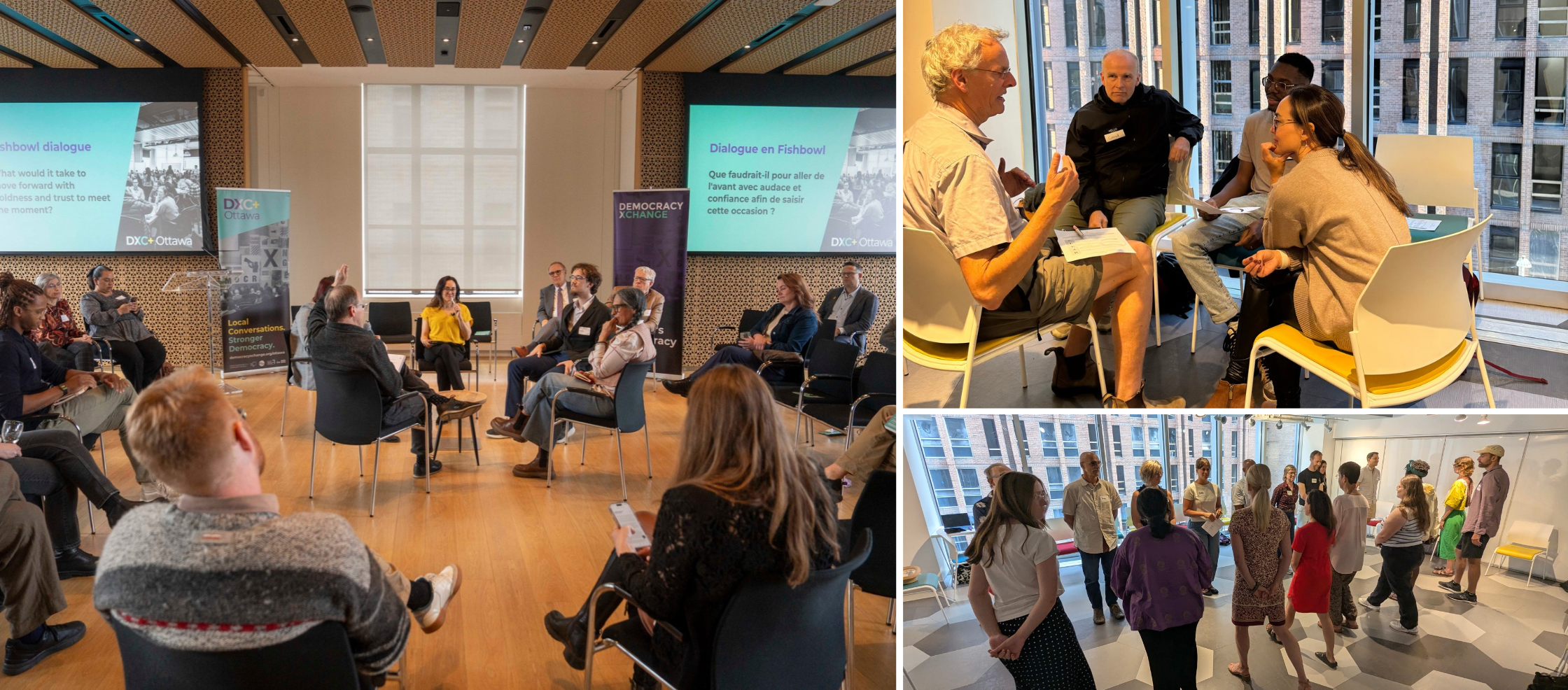
Our experiments ranged from intimate practice spaces to a major public conversation. They included:
• One public gathering on Canadian identity, with the Pearson Centre and The Other Hill, marking the 60th anniversary of the Canadian flag and asking what it means to be Canadian
• Two open practice gatherings in Ottawa, where people could connect, learn dialogue practices and try them together
• One larger public conversation, co-hosted with the Open Democracy Project as part of DemocracyXChange, which brought approximately 80 people together for a panel and participatory dialogue exploring: Can we move fast without losing what matters?
• 15+ online meetups connecting people already doing, or hoping to do, bridge-building work
• Countless conversations with organizations working across democracy, belonging and civic participation about what we were each learning and how we might support one another
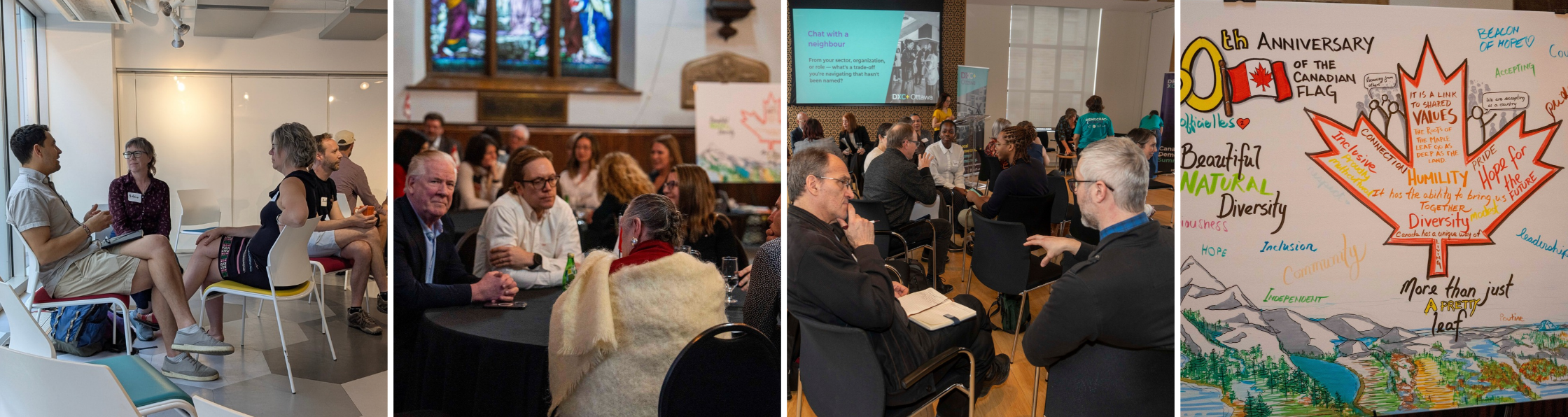
These experiments showed us something important about the appetite for dialogue, the conditions that make it possible and what it will take to sustain it.
3. What we learned
Lesson 1: People are hungry for meaningful connection
Again and again, we were struck by the interest, warmth and honesty people brought into the room.
Participants valued the opportunity to be curious together outside the usual debate format. They wanted to meet as human beings, not as opposing positions. At a time when so much of public life is filtered through headlines, algorithms, and anonymous exchanges, simply being in genuine conversation felt significant.
There is a real appetite for spaces where people can slow down, say what they are actually thinking and encounter perspectives beyond their own.
Lesson 2: Dialogue capacity needs to exist before a crisis
How a gathering is framed shapes how people enter it. Do they arrive ready to defend a position, or ready to encounter one another?
We found that gatherings without a specific theme or topic for debate still brought a real diversity of opinion, but fewer fixed positions to declare. That made room for more meaningful connection.
This changed how we thought about the purpose of gathering. We began to see dialogue as a form of preventive health care for communities.
Too often, we create spaces for conversation only after an issue has erupted and positions have hardened. What if communities already had the relationships, skills and trusted spaces needed to work through difficult issues before reaching a breaking point?
Lesson 3: Dialogue is a muscle most of us were never taught to use
Across gatherings, people told us they didn't feel equipped to navigate difference without defending, debating, or disengaging.
Many of our institutions teach us how to present an argument or win a debate, but offer far fewer opportunities to sit with disagreement, ask a genuine question or remain curious when something challenges us.
Dialogue is a skill. Like any skill, it has to be learned and practised.
Well-held spaces where people can strengthen that muscle also build confidence for the next hard conversation, including the ones with the people closest to us.
Lesson 4: Bridge building is not about manufacturing agreement
What we witnessed was not necessarily people changing their minds. It was the softer and possibly more important act of people examining their assumptions, understanding one another more fully and staying in relationship, including when faced with disagreement or difference.
At one gathering, a participant had a lot to say about what immigrants to Canada should not be. Rather than debating him, another participant asked: "What would your ideal immigrant to Canada look like?" He couldn't answer.
Later, he reflected that he knew what he was against, but wasn't sure what he was for. His mind wasn't neatly "changed." But the right question, asked in a carefully held space, created an opening for reflection and a moment of connection where there might otherwise have been a standoff.
That is the subtle impact of active bridge building. It brings forward the possibility to remain curious and connected long enough for something new to emerge.
Bridge building is also not about "hearing both sides." Not every claim deserves equal weight, and not every conversation is safe to stay in. Holding these spaces well means setting boundaries, paying attention to power, and being ready to step in when harm shows up. The goal isn't civility at any cost. It's creating the conditions for honesty, reflection, and continued relationship where that is possible.
Lesson 5: Bridge builders are everywhere, but goodwill is not infrastructure
We met people doing this work in their communities, organizations, and relationships, often in small ways and without much support.
Creating a regular place for these bridge builders to connect helped people feel less alone. It allowed practices and ideas to spread. But the need is too great to depend indefinitely on volunteer energy and small organizations.
Meaningful dialogue requires time, skilled facilitation, trusted relationships, places to gather, and sustained investment.
In our search for support, we encountered a gap. Large institutional grants often required academic partnerships or formal research. Smaller community grants tended to support one-off events. We found few accessible options for sustaining regular dialogue spaces or a community of bridge builders over time.
Goodwill can start the work. It cannot sustain the infrastructure.
4. What we think Canada needs now
Canada needs dialogue infrastructure. That means:
• People with the skills and confidence to host meaningful conversations
• Trusted spaces where people can gather before a crisis
• Strengthened relationships capable of holding disagreement and difference
• Practical tools that communities can adapt and use
• Skilled facilitation that attends to power, participation, and harm
• Long-term investment in the people and organizations doing this work
These things may feel small compared with the scale of the challenges we face. But democracy is sustained not only through institutions, elections, or moments of national urgency. It is also sustained through the everyday practice of being in relationship across differences, confronting difficult issues, and taking responsibility for our shared future.
5. What comes next
We are not alone in seeing the need for more sustained civic infrastructure.
A coalition of leading organizations in the democracy sector are calling for the creation of a Canadian Democracy Endowment: a permanent, non-partisan, and arm's-length mechanism to build and sustain civic infrastructure. We support the proposal, encourage others to add their endorsement and are hopeful it receives the necessary support in the Fall Federal Budget.
We also believe there is a role for Bridge Building Group.
This year of conversations showed us that the need is real and the work is far from finished. We are exploring what it could look like to train and connect more local hosts, develop practical tools for dialogue, and sustain a wider community of bridge builders.
We started because we felt we had to do something.
We've learned that the "something" may be smaller, slower, and more sustained than a single dramatic act. It lives in the regular practice of gathering, listening, questioning, and staying connected. It grows one meaningful conversation at a time.
We're not done.
If you are funding civic infrastructure, hosting conversations in your community, doing complementary work or interested in helping build what comes next, we would love to hear from you.
Authors
Jane Porter, Co-founder, Bridge Building Group
Jane is a Certified Professional Facilitator (Integral® and IAF Certified™) with over 15 years of experience (national and international) as a convener and consultant bringing a depth of process skills and content knowledge.
Katie Miller, Collaborator, Bridge Building Group
Katie has spent her career working toward a more sustainable and equitable future. That work has led to the belief that so many of our biggest challenges trace back to disconnection, from ourselves, each other, and the land, and that spaces and skills for more meaningful dialogue across differences are essential to building something better.
